Mice getting into a multi-building co-op in Vancouver
A housing co-op spread across several low-rise buildings in Vancouver had confirmed mouse activity inside one of its units. The building itself wasn't unusual: wood siding over a concrete foundation, yard gates tucked against the walls, heat pumps and downspouts along the exterior. What made the job worth doing properly was scale. This wasn't a single bad seal on one door, it was a pattern running the length of the building.
Getting into co-op units comes with its own rhythm of advance notice to residents, which meant the work had to be planned as an exterior-first job: find every point along the perimeter where the building envelope had opened up, and close it from the outside before touching anything indoors.
A consistent gap at the foundation line, plus smaller pop-outs
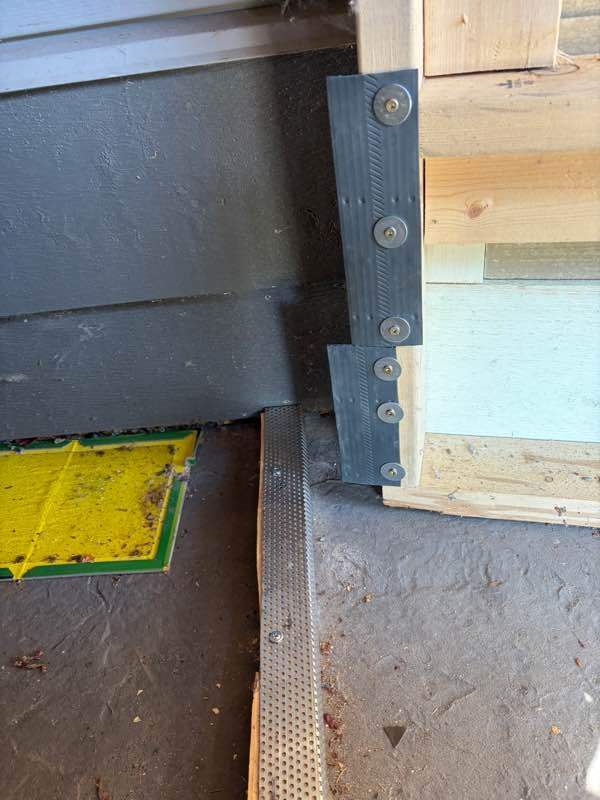
The inspection found what the crew often sees on older wood-sided buildings: a fairly consistent gap running almost the entire perimeter, right where the siding meets the foundation. In a few spots, exposed bug net was visible around the green siding sections, meaning the original barrier had already failed there. Gaps also showed up underneath the white siding corners and around the doors, the kind of detail that's easy to walk past unless you're looking for it specifically.
Two smaller problems stood out beyond the main perimeter line. A gap in the wall beside one unit's door gave mice a direct route in beside the frame. And on both sides of the building, a roughly 6-inch by 6-inch pop-out had opened where the yard gates met the structure, basically a hinge-point gap that nobody had thought to close when the gates went in. A full look at the crawlspace below couldn't rule out entry from underneath, so the exterior work was scoped as the first pass, with the understructure flagged for a separate follow-up.
Flashing the perimeter and meshing the gaps
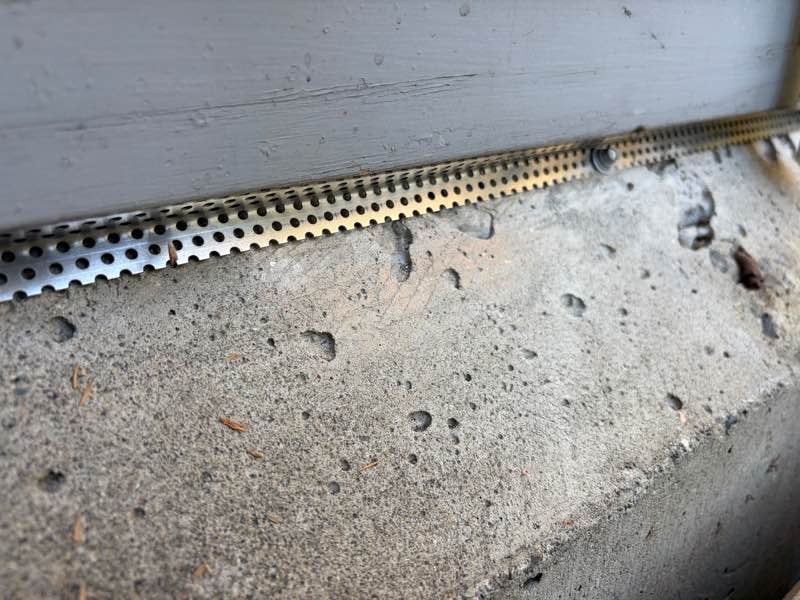
The crew installed roughly 150 feet of 0.5-inch by 1-inch flashing along the siding-to-foundation line, closing the main gap that ran around the structure. That's the backbone of this kind of job: flashing bridges the seam between two different materials (wood siding, concrete foundation) that were never going to seal tight against each other on their own, and it's durable enough that normal weather and settling won't reopen it the way caulk or foam would.
The gap beside the unit door and the two gate pop-outs were sealed with steel mesh, packed tight enough that nothing can chew or push through. Interior sealing was deliberately held off until this exterior pass was finished, standard practice on an active mouse job: seal the inside first and you risk trapping live mice in the wall cavity, which solves nothing and creates a worse problem.
Two spots needed a judgment call. Rotten wood behind a drainpipe in one unit's yard, and rotten corner trim near a heat pump on another unit, wouldn't hold screws. Rather than leave those gaps open, the crew packed them with stuffing as a temporary seal and flagged both for wood replacement, since that's a carpentry fix rather than an exclusion one.
The Outcome
We were hired to close the entry points letting mice into the building, and the exterior exclusion scope is done. Every feature identified in the assessment, the perimeter gap, the door-side gap, and both gate pop-outs, was treated with flashing or steel mesh as quoted.
Perimeter sealed, two repairs flagged
- The siding-to-foundation gap running the length of the building is now closed with roughly 150 feet of flashing instead of sitting open along the perimeter.
- The gap beside the unit door and both yard-gate pop-outs are packed with steel mesh, removing three of the access points mice had been using.
- Two sections of rotten wood that couldn't take screws were temporarily secured with stuffing so they aren't sitting open while replacement is scheduled.
- Interior sealing was held off deliberately so this exterior pass could close the building up without trapping anything inside the walls.
The standing recommendation out of this visit is to monitor plant growth near the siding, since vegetation pressed against a sealed wall can eventually compromise the barrier again, and to get the two rotten-wood sections replaced rather than left on stuffing long-term. For co-op and strata buildings dealing with the same wood-siding-over-concrete setup, this is the same approach we bring to entry-point exclusion and mouse control work elsewhere in Vancouver, and it pairs with a crawl space check where the understructure can't be ruled out as a second entry route. More on how mice get into buildings like this is on our house mouse page.
Need Pest Proofing?
Comprehensive exclusion audit and sealing of all entry points. The last pest service your property needs.
View Pest Proofing