

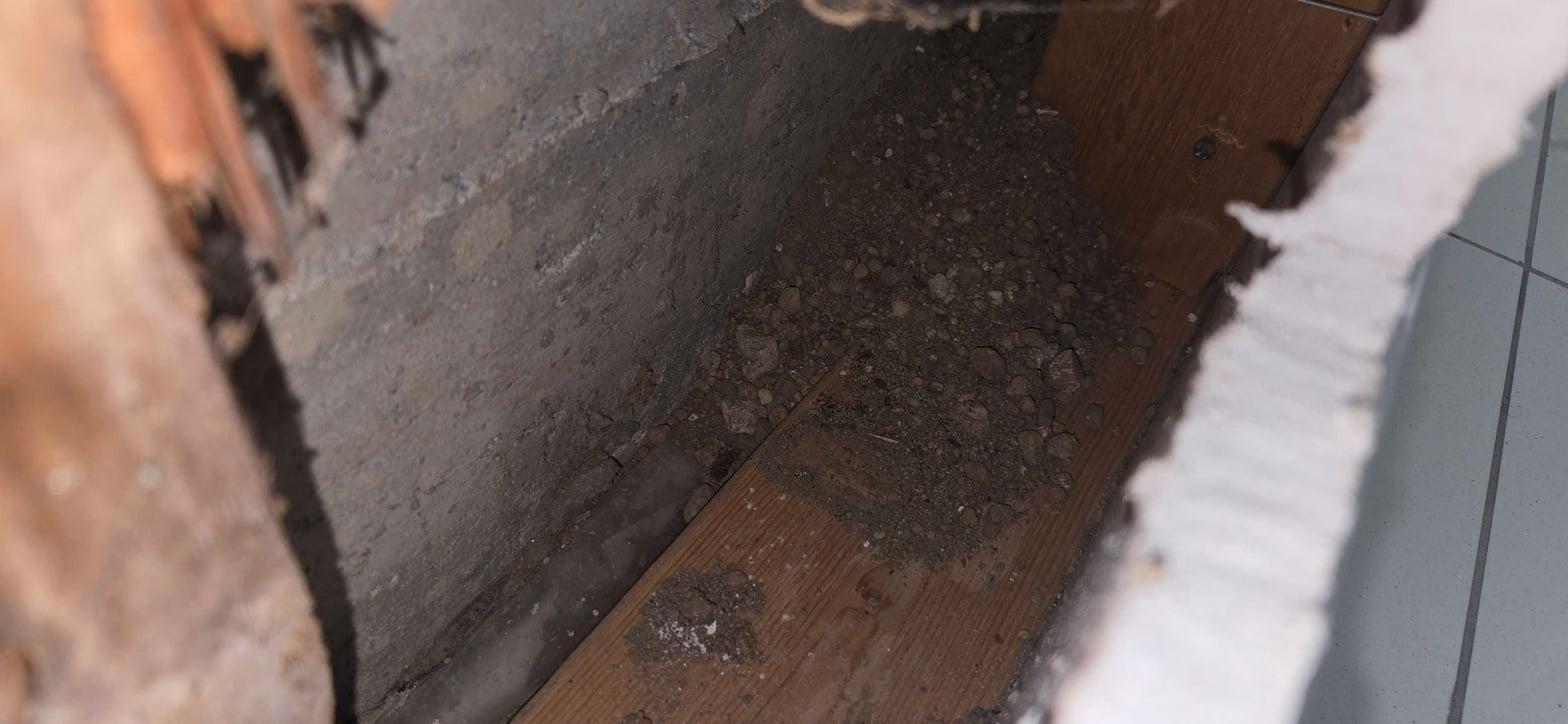
Mice getting into a finished Burnaby basement
The basement was finished, with the same footprint as the main floor above it, which meant the crawlspace underneath, what techs call the hell pit, was the only place rodents could be moving through. The homeowner and a previous pest control company had already done some DIY sealing work. It helped some, but the activity kept coming back, which is usually a sign the real entry point was never found in the first place.
That's the pattern with hell pits generally: plastic, silicone, and spray foam get pressed into gaps around pipes and pads, and it looks sealed from above, but none of those materials hold up to a mouse working at them from underneath in the dark. Concealed voids like this can't be fully assessed until they're actually opened up.
Nearly every pipe and clean-out had a gap underneath it
Once the crawlspace was opened and inspected properly, the scale of the problem became clear. Almost every pipe and clean-out had a large gap underneath it. Both bathtub areas had the same issue, and a running seam along the bottom wall of the crawlspace had a gap wide enough for rodents to use as a thoroughfare.
The homeowner had flagged one area in particular, the corner left of the hot water tank, as his main concern. It turned out that hole wasn't actually the entry point into the house. It was the opening into the crawlspace from the interior wall, but the rodents were getting through the foundation itself, through utility penetrations about two to three feet below that hole. Finding that distinction mattered: sealing the visible hole alone would have left the real gap untouched and the activity would have kept coming back, the same outcome the earlier DIY work had already produced.
Sealing the crawlspace with concrete and tracing the real gap
Every identified gap, the pipe and clean-out penetrations, both bathtub areas, and the wall seam, was sealed with concrete rather than foam or caulking, which holds up far better against gnawing and moisture in a below-grade space. A section of wall beside the crawlspace was opened to reach a concealed void shared with the garage and a central air duct penetration, so that space could be inspected and sealed too.
A follow-up visit checked the cured concrete and confirmed the utility penetrations near the water heater, the actual entry route, were properly closed. Drywall that had been opened during the crawlspace work was patched. On a final short visit, a piece of flashing was installed in the crawlspace at the homeowner's request, extra assurance at the water heater corner that had worried him from the start.
The Outcome
We were hired to find and close off the rodent entry point in a finished Burnaby basement after earlier sealing attempts hadn't worked, and to get it properly documented. The gaps are sealed, the real entry route is closed, and the crawlspace has been checked and confirmed clear on repeat visits.
Sealed, inspected, and quiet
- Every pipe, clean-out, bathtub gap, and wall seam in the crawlspace is sealed with concrete rather than foam or caulking.
- The actual entry point, utility penetrations below the water heater hole, is identified and closed, not just the opening that looked like the problem.
- Drywall opened for access was patched, and flashing was added in the crawlspace for extra protection at the area the homeowner was most concerned about.
- Follow-up visits recorded zero pest activity, with monitoring continuing at the same frequency to confirm the result holds.
Hell pits like this one are a good example of why crawl space treatment needs to go further than patching the obvious hole. Entry points are frequently several feet from where the damage is visible, and tracing them properly is what separates lasting entry-point exclusion from a repeat callback. For background on how house mice exploit small structural gaps, see our pest library entry.
Need Hell Pit Access & Exclusion?
Structural access point assessment, securing, and exclusion for sub-floor and below-grade spaces.
View Hell Pit Access & Exclusion