

Mice in a Port Moody townhouse unit
A resident in a Port Moody townhouse block called about mice in the kitchen. There hadn't been a sighting, just the usual quiet evidence: a few droppings near the dishwasher. That's often how these jobs start. Mice are nocturnal and good at staying out of sight, so by the time anyone notices activity, they've usually been moving through the wall voids for a while.
The first visit was an interior inspection: kitchen, pantry, living room, bathroom. The technician found droppings behind the dishwasher, right next to a gap that ran down into the wall space. That's a classic mouse travel route. Appliances create warm, undisturbed voids behind them, and any gap at the floor or baseboard becomes a highway into the wall cavity and beyond.
A gap behind the dishwasher, and a door that didn't seal
The interior finding only explained half the picture. Mice don't appear inside a unit on their own, they're coming in from outside somewhere, and in a townhouse block that often means a shared building envelope rather than anything specific to one unit.
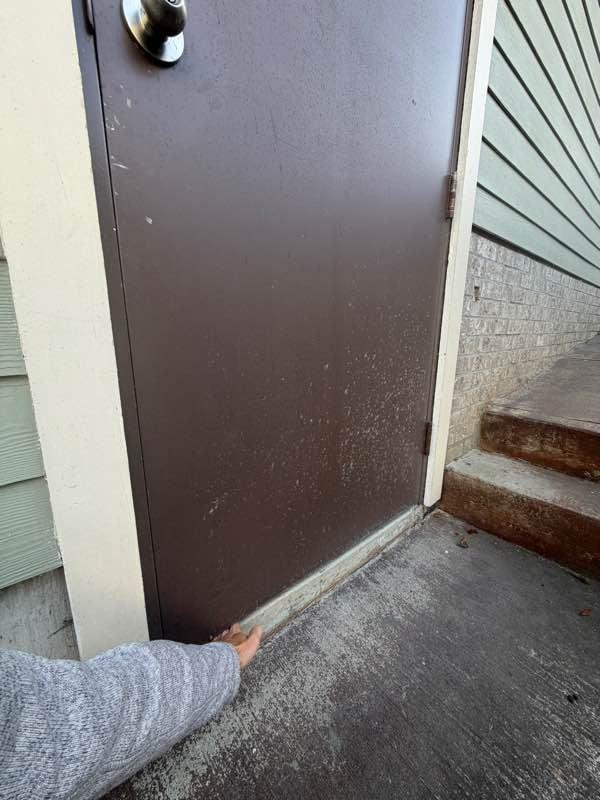
A second, separate visit looked at the exterior. Full interior access wasn't available that day and not every side of the building or yard could be checked, so the inspection was scoped as preliminary. Even with that limitation, two clear issues turned up on the unit itself: the side utility door had roughly a one-inch gap along the bottom, wide enough for a mouse to pass through without any trouble, and the siding had flashing installed along the underside in some sections but not consistently for the full run. Garage doors were tested from the outside and looked acceptable, so they weren't flagged as a likely entry point.
Taken together, the interior gap behind the dishwasher and the exterior gaps at the door and siding lined up as a plausible route: mice getting in through the building envelope and then finding their way along interior wall cavities toward the kitchen.
Monitoring stations and a proofing plan
The response had two parts. Inside, seven interior rodent traps went in across the residence as part of an ongoing biweekly mouse control program, backed by exterior monitoring stations at the building perimeter. No poison was used, this was a trap-and-monitor approach so activity could be tracked visit to visit without introducing bait around a residential building.
The exterior findings were written up separately with photos and a specific proofing scope: a door sweep sized for the side utility door to close the bottom gap, flashing completed along the siding run where it was missing, corner excluders at the identified gaps, and one-way doors installed at active mouse entry points so animals already inside the wall voids could leave but not re-enter. That kind of sequencing matters on an exclusion job, you don't seal every opening on day one; you let the one-way doors clear the space first, then do the permanent seal on a return visit, which entry-point exclusion work generally requires.
The siding is a shared building surface across the complex, so that part of the proofing scope wasn't something that could just proceed on the spot. The findings and photo report were prepared so the resident could bring them to the strata for review, since work on shared siding typically needs that sign-off before a crew can carry it out.
The Outcome
We were hired to stop mouse activity in the unit through trapping and monitoring, and to work out where mice were getting in from outside.
Stations came up clean on the visits recorded, proofing plan left for the strata
- Interior and exterior monitoring stations showed no further catches on the visits recorded after the initial setup.
- The resident confirmed no renewed sightings, droppings, or gnaw marks at the follow-up checks that took place.
- The gap behind the dishwasher and the exterior entry points (utility door gap, incomplete flashing) were documented with a clear proofing scope: door sweep, flashing completion, corner excluders, and one-way doors.
- Exterior sealing work is scoped and quoted but sits pending strata approval, since the flashing work touches shared building siding rather than anything inside one unit.
The case is a good example of why a mouse complaint inside one unit is often a building problem, not a unit problem. Trapping alone would have kept the kitchen quiet for a while, but without closing the actual gaps at the utility door and siding, activity tends to come back once the easy entry point is still open. For anyone managing a multi-unit property dealing with similar signs, our pest-proofing and house mouse pages cover what these entry points typically look like and how sealing is usually sequenced around active trapping.
Need Mouse Control?
Full-property baiting, trapping, and entry point sealing to eliminate and prevent mouse activity.
View Mouse Control