Mice turning up in units across two buildings
This strata's mouse problem would not stay in one home. Mice kept showing up inside various units in both of its townhouse buildings: a southeast block with eight units and eight storage sheds, and a northwest block with six units and three sheds. When neighbouring homes keep reporting the same pest, the cause is usually a building with several small ways in, not one tenant's housekeeping or one obvious hole.
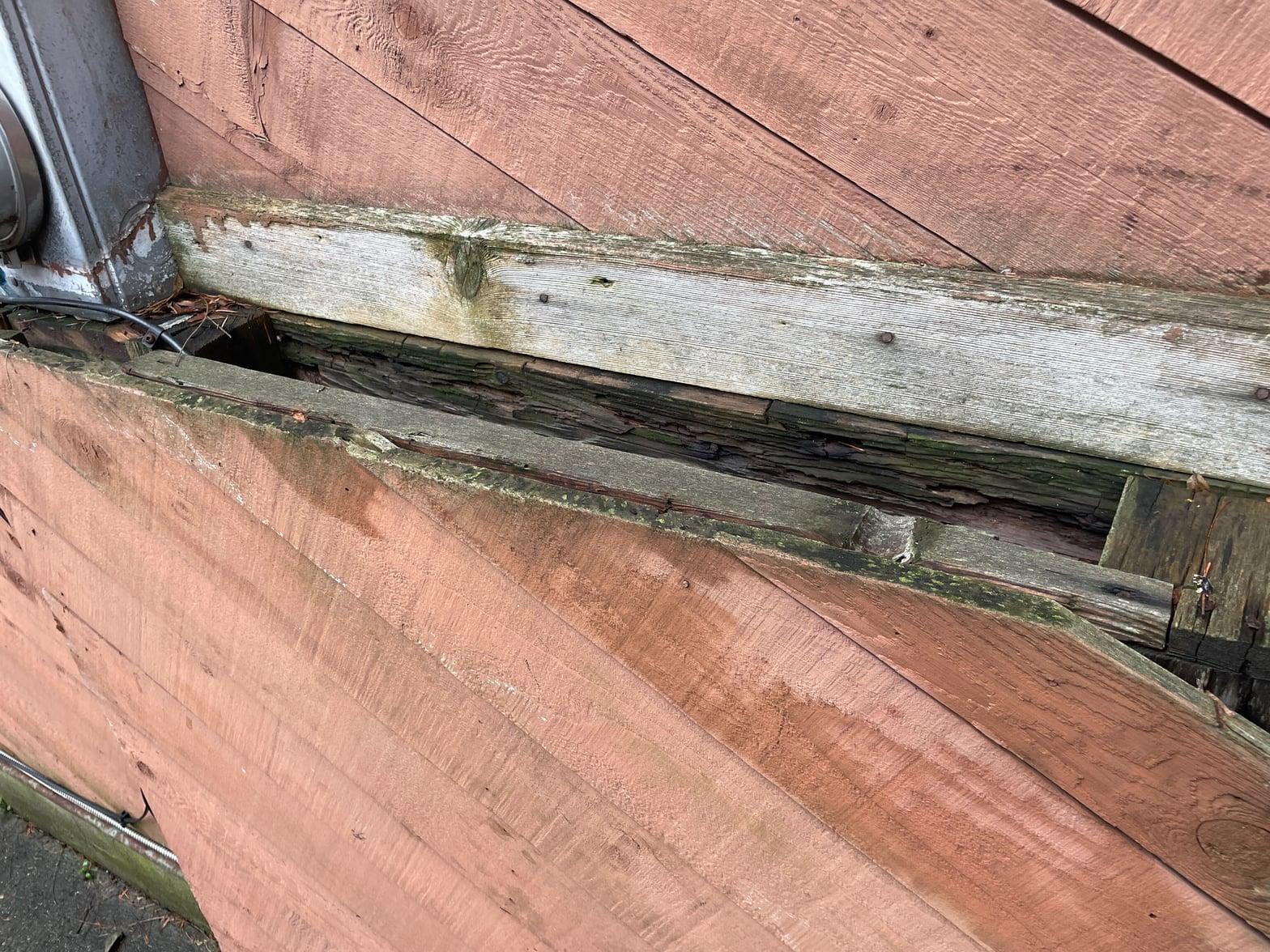
Mice need very little room. A house mouse can get through a gap about the width of a pencil, and a young one can get through less. Townhouse cladding sits over a cavity, and wherever trim, a corner cap or a fixture interrupts the siding, that cavity can open to the outside. Once inside, mice follow wall voids, runs of framing and shared walls. One weak corner can feed more than one home, so fixing one unit at a time rarely ends a complex-wide problem.
Corner caps, shed seams and patio separators let them in
The two buildings were leaking in different ways. On the southeast building, mice were getting in mainly through the storage sheds, through intermittent siding gaps front and back, and through the shared patio separators between backyards. Shed walls are built from framing and panels, and a seam that looks tight from the yard can still leave a mouse-sized opening at the base or a corner. A shared separator links one yard to the next, so a mouse that reaches one patio can reach the others.
The northwest building was harder to read. Mice there were getting in mainly through the siding corner caps and through intermittent siding gaps. The scope called for a slow, careful inspection to find each one-off access point and close it on its own. A cap can look fine from the walkway and still have a gap behind it where the siding ends.
Owners with a similar problem can check for the same signs:
- Droppings along the base of shed walls, under deck skirting or behind items stored against the siding
- Dark, greasy rub marks along the edge of a gap, where fur has worn a line
- Gnaw marks on cap edges, trim or soft filler
- Scratching or rustling inside a wall after dark
Start at the siding corners and the bottom of shed walls, because those are the spots people rarely look closely at.
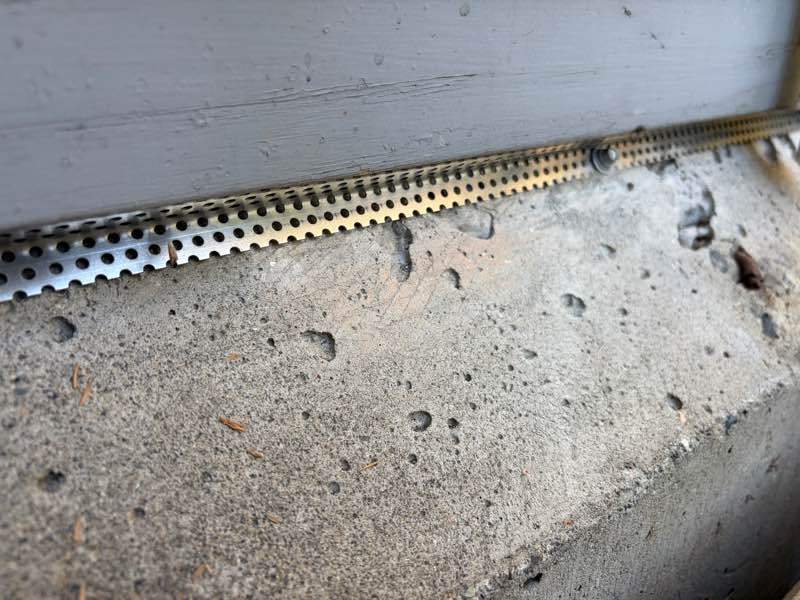
The usual quick fix is to stuff a gap with spray foam or steel wool. It often fails. Mice chew through foam, loose wool gets pulled out or works free, and caulk alone can crack at a corner that shifts with the weather. Steel mesh and metal flashing hold up because a mouse cannot chew through them.
Closing the routes on the outside, then trapping around the buildings
The scope for both buildings covered the interior wall perimeter and seams of every storage shed, using steel mesh and flashing. It also covered spot repairs along each unit's siding line and corner caps, plus any other weak points found during the work. On the southeast building, the scope added the two retaining walls beside the front stairs and the shared patio separators between backyards. On the northwest building, it called for intensive inspection for one-off entry points.
Before the work, owners were asked to empty all storage sheds and clear belongings off the siding at the front and back of every unit. That step matters on any exclusion job. You cannot close a gap you cannot see, and items stacked against a wall hide exactly the spots mice use. We did the northwest building over two visits. Once the exterior proofing was confirmed complete, no further proofing visits were needed.
Exterior trapping followed for a specific reason. When a route is closed, the mice that were using it look for another way in. Lowering the number of mice living around the buildings takes pressure off the new work. The goal is to manage that resident population, not to remove every mouse from the grounds. The strata approved a one-year program of monthly checks on exterior trapping stations, with a service report after each visit. Mice already inside a unit are a separate problem, and interior trapping is what deals with them. Interior trapping for affected units was offered as a separate option, decided by the owners of those units.
The Outcome
The strata hired us to stop mice getting into units across both townhouse buildings by closing the ways they were coming in from outside. That work is done.
Mouse entry routes closed across the complex
- The exterior proofing is complete, so the routes mice were using around the buildings are now closed.
- The scope covered each unit's siding line, corner caps and shed seams.
- A year of monthly checks on the exterior trapping stations keeps pressure off the new work, and the strata gets a report after each visit.
- The workmanship is covered by a one-year warranty. As is standard, the warranty does not cover mouse activity itself.
The strata's representative said the crew delivered on time and on budget.
If you see the same pattern at your own complex, with mice in more than one unit or more than one building, walk the siding corners and the bottom of shed walls with a flashlight first. Clear stored items away from the walls and look for droppings, rub marks and gnawing. Don't count on spray foam at a mouse entry, because foam is easy to chew through. When several homes are affected, have the whole exterior inspected rather than patching one unit at a time. See our pest-proofing service, mouse control and strata program for how this work is scoped.
Some photos on this page are representative photos from similar jobs our crews have done, not photos of this property.
Need Pest Proofing?
A full exclusion audit, then every entry point closed. The last pest service your property needs.
View Pest Proofing More pest proofing in Coquitlam