

In this article
Mice in one strata unit are a building question because they travel through the walls, service chases, parkades and common areas that every unit shares. Treating a single suite rarely settles it. A council needs a record of every floor and every entry point to know whether the building is actually getting better.
What does a typical pest control report tell a council?
It usually tells a council that someone visited, and little else. A one-line ticket that says "serviced" doesn't show which devices were checked, where they sit, what was found or whether activity is going up or down. There is no map to forward, no photos of the gaps, and nothing a council member can put in front of owners at the next meeting.
FieldHive is the system NewGen built for its own crews, and we run it on every job. It turns each visit into a record a council can read without calling anyone.
Why does one unit with mice point to the whole building?
Because the gaps mice use are rarely confined to one suite. Mice need very little room. The Province of British Columbia notes that mice can gain access through a dime-sized opening, while rats only need a quarter-sized hole. Health Canada makes the same point and adds that even the small gaps created by worn thresholds under doors will allow mice access to your home.
In a strata building, plumbing and wiring run up shared chases. Parkades connect to garbage rooms, storage lockers and mechanical spaces. A mouse that turns up in one unit may have used a route that other units share, and a gap in a common wall is a gap for everyone on that line. Rodents will cross property lines, and the same logic applies between suites.
Why does treating one unit rarely end it?
Treatment inside one suite deals with the mice in that suite. It does nothing about the route they used to get there. The Province advises that rats and mice reproduce quickly, and ignoring an occasional invader can result in a much more damaging infestation. Health Canada says the same thing from a different angle: mice and rats are prolific breeders, so tackle occasional invaders right away.
The lasting fix is exclusion at the shared points: gaps along the foundation line, penetrations into service chases, the parkade wall, the bottom of garage doors, and anywhere pipes and cable pass into a common space. Exclusion closes the route, and monitoring shows whether it held. You need both, which is why the Province recommends combining prevention and control methods.
What should a council ask for after every visit?
A report that answers these questions without a phone call:
- Which devices were checked, and when
- What was found at each one, by floor and room
- Which entry points and gaps were located, with photos and measurements
- What the contractor recommends, and what needs repair
- Whether activity is trending up or down over time
If a device was skipped, the report should say why. Without that record, a council is left taking the contractor's word that the building is handled.
How does FieldHive show what is happening on every floor?
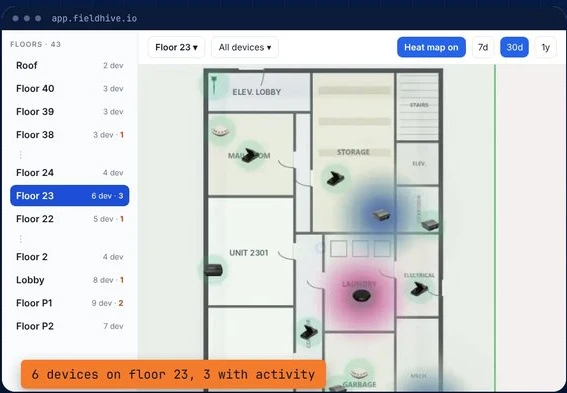
Every device NewGen places is on a map. Indoor devices sit on floor plans of each floor, and outdoor devices sit on an aerial map of the property. Each device is checked and recorded on every visit, and a skipped device gets a recorded reason.
Findings go on the map too. Entry points, gaps, damage and sanitation issues are photographed, measured and marked where they are, so the next technician and the council are looking at the same spot. Repair items arrive on the map one by one and can be approved with a typed signature, from a phone if that's easier.
Heat maps show activity over 7 days, 30 days or a year, inside and out, so you see where the activity is, not just how much. Activity charts break the numbers down by month, species, building and room. A floor filter runs from the parkade to the roof, so even a tall tower can be read one level at a time. Reports can be searched by property or date, and any report can be printed or saved.
Since January 2025 we have delivered more than 1,400 visit reports across more than 240 client sites. That is the record behind what strata councils get after every visit: the same map and the same level of detail, every time.
Can residents report a mouse without an app?
Yes. A QR poster in the lobby lets residents pin the problem on a map of the building and attach a photo, with no app to install and no password. The report goes on the technician's next visit, and the answer is recorded as confirmed, nothing found, or couldn't get access, with a note. The property manager chooses which buildings get a poster.
In strata this matters because a mouse seen in a hallway is information about the building. A resident's photo can point the technician toward a chase or a parkade wall early. Residents report it in a minute, and council sees what we found.
What does a property manager or council get out of it?
A manager gets out of the middle. Property managers can see every property on one portfolio map, clients can log in to see their own properties at any time, and site staff can have logins limited to their own site. When someone asks what happened last month, there are no calls and no forwarded emails. The record is already there.
A council's question is simpler: is it actually getting better? The answer comes from the trend lines, room by room and month by month, not from the last ticket. Councils that want exclusion and monitoring across the whole building can start with our strata program, and we can show a working demo built on your own addresses.
If your council is dealing with mice in one unit, decide what the building's record should show before the next visit. Start with what strata councils get after every visit.
Sources
- Province of British Columbia, Managing rat and mouse pests (2023)
- Government of Canada, Rats and mice (2016)
Frequently Asked Questions
NewGen Pest Control Team
Pest control specialists serving Greater Vancouver since 2016.7× Consumer Choice Award winners.