

In this article
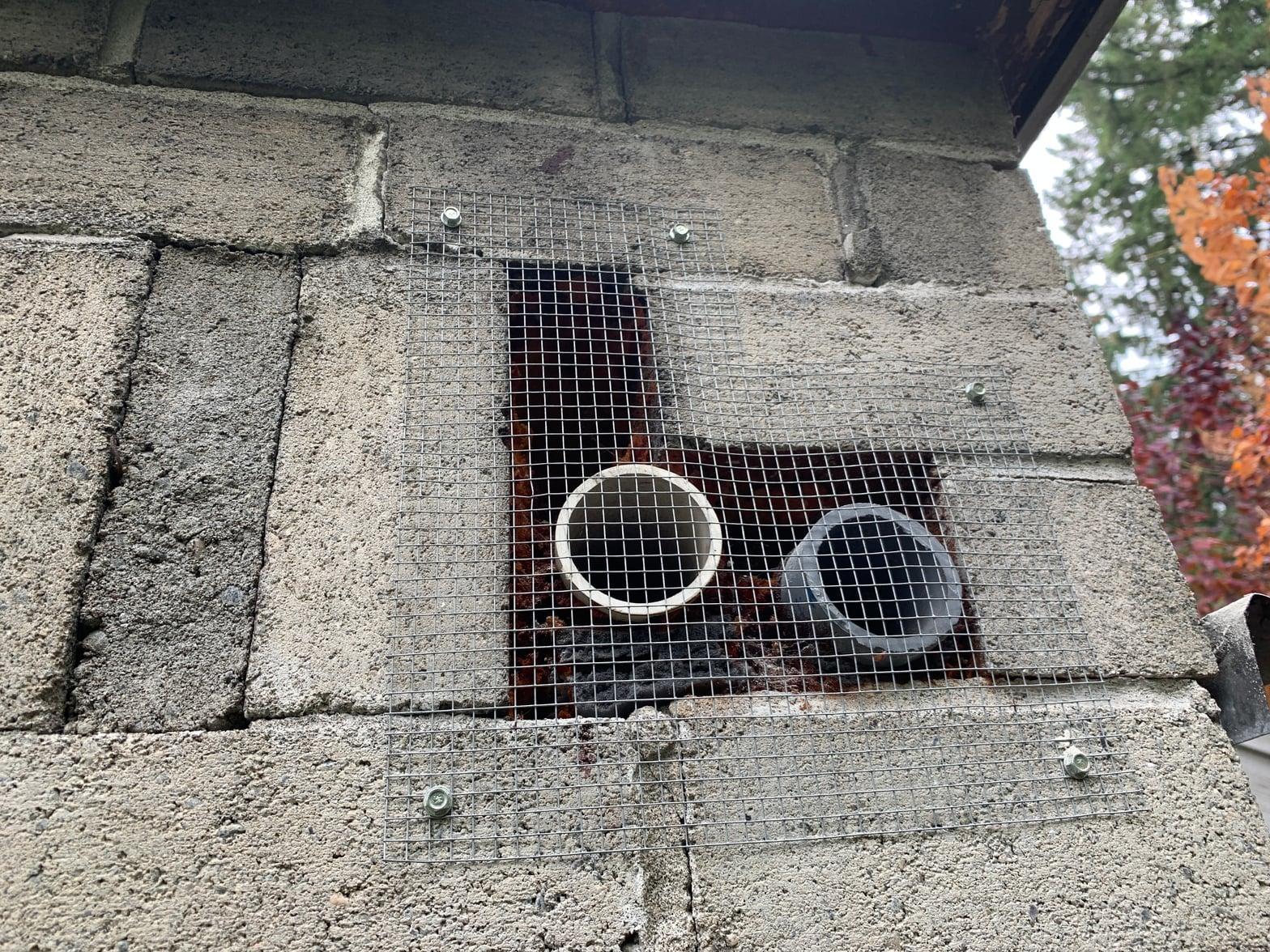
Mice get in where a building was cut open for something else: the hole behind a baseboard heater, the gap where a pipe or cable enters the wall, the edge at the base of a ramp, and the space under a garage door sweep. A mouse can use an opening about 1/4 inch across. The lasting fix is exclusion: close each opening with metal mice can't chew, not rubber, foam or steel wool alone.
Where do mice get in behind baseboard heaters?
Through the wall penetration behind the heater, not the heater itself. A baseboard heater sits at floor level on a wall that has wiring running through it, and the hole cut for that wiring is often bigger than it needs to be. Behind the heater, a mouse has a route into the wall cavity, and in an older building that cavity can connect to other parts of the structure. University of Nebraska-Lincoln Extension notes that mice can use holes as small as 1/4 inch in diameter.
On one of our jobs, mice were coming through holes behind the baseboard heaters. The caller wanted the heaters taken off and the penetrations closed rather than another trapping program. That's the right instinct. Traps deal with the mice already inside, but an open hole keeps letting new ones in. Our mouse control work starts by finding that kind of hole.
On another job, the work covered the door frame weather strip as well as the baseboard heaters. Door frames deserve the same attention, because rats and mice can quickly gnaw through rubber or vinyl weather stops ( University of Nebraska-Lincoln Extension).
Do pipes and utility gaps let mice in?
Yes. Extension guidance lists openings around augers, pipes, electrical conduits and cables as common routes into buildings ( University of Nebraska-Lincoln Extension). The hole drilled for a pipe or line is usually wider than the line itself, and that leftover ring of space is the entry point. Exterior utility enclosures and hose bibs are worth a look too, since insulation packed around pipes gives mice both cover and nesting material.
Timing matters. When it gets cold outdoors, mice leave their nests in grass, brush or woody areas and look for warmer places like homes, and it only takes a small crack or an open door ( University of Georgia CAES Field Report). In our call records, mouse calls peak in August, September and October, so close the gaps before the heating season rather than after the first droppings show up.
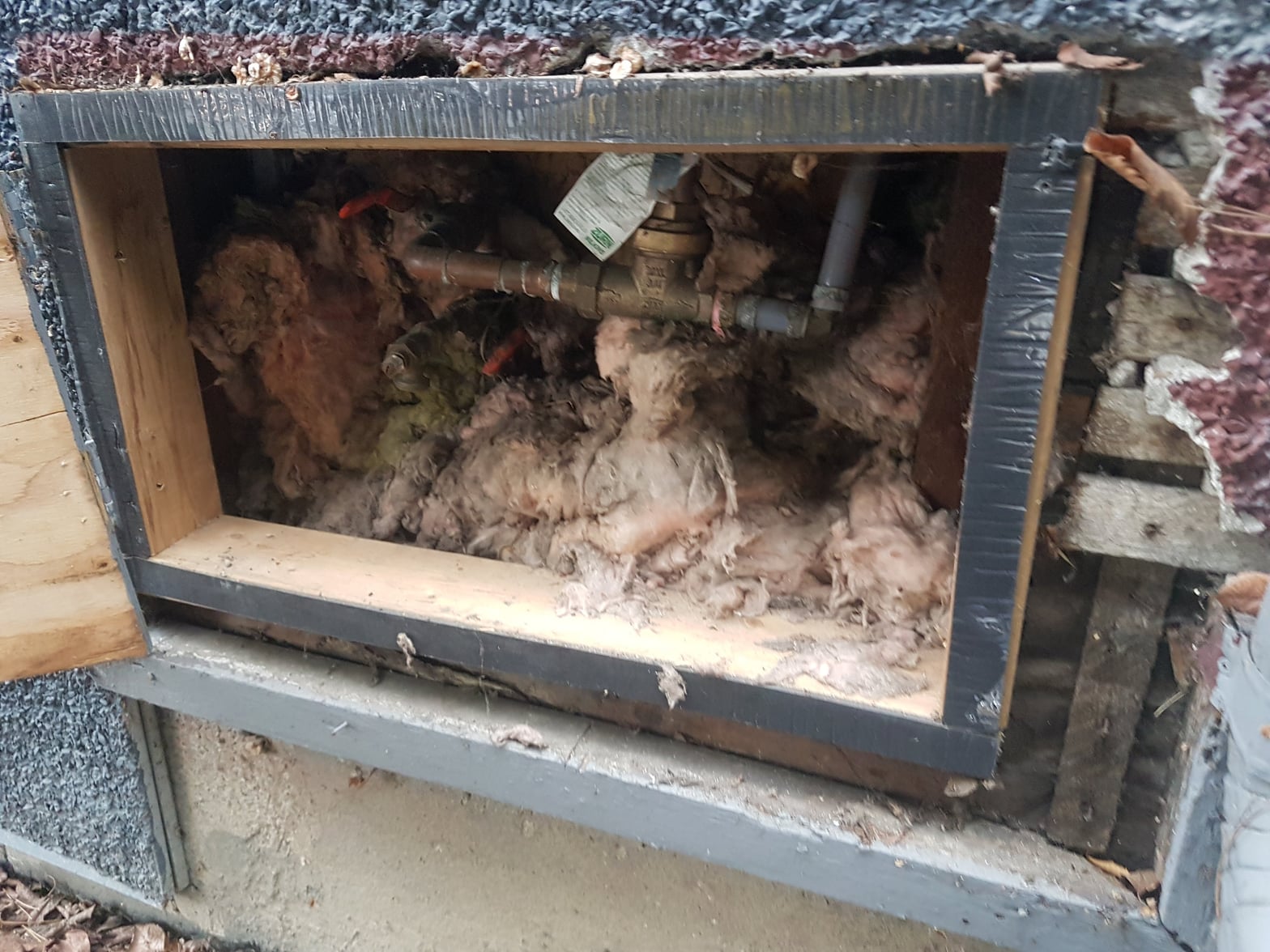
On one of our proofing jobs, the scope included closing the utility line gaps around the perimeter. Caulk belongs over the top once the metal is in. On its own it's a thin layer that mice can chew through.
Signs that a pipe or utility gap is in use:
- Dark rub marks along the baseboard, pipe or conduit line
- Droppings on the floor or a ledge beside the wall
- Displaced insulation near a wall, vent or outside penetration
- Chewed wire sheathing
- Scratching or movement inside the wall at night
On one job, disturbed exterior insulation and chewed wiring pointed to an entry gap that trapping alone would not address. On a different job, insulation pushed out from outside, chewed wiring and attic noises were treated as signs of an active entry point.
Why do ramps and garage door sweeps let mice in?
Because they meet the ground, and the joint where they meet is rarely tight. Garage door sweeps wear down, lift at the ends and harden over time. A ramp often leaves a gap where the concrete meets the wall.
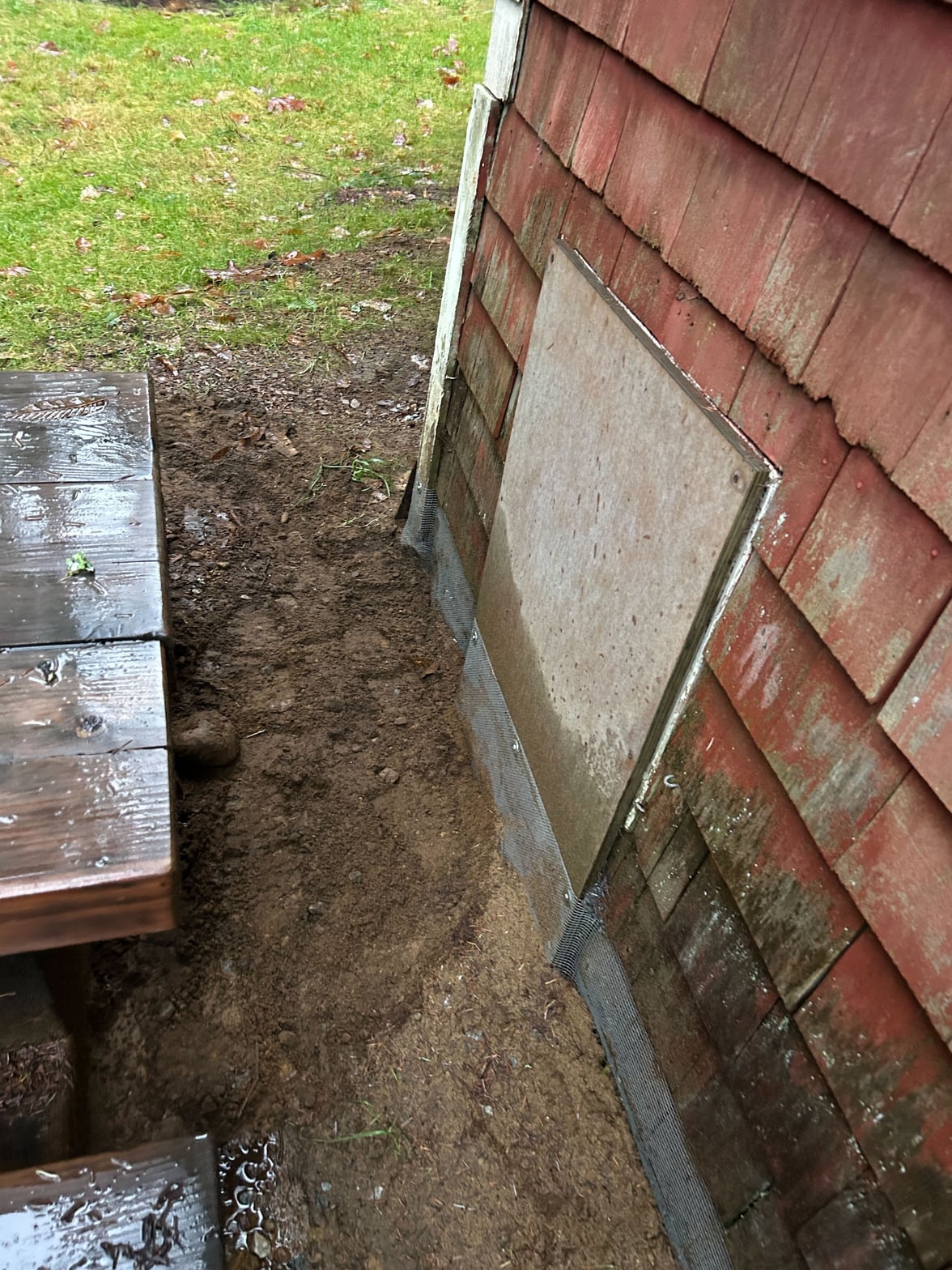
The same proofing job that covered the utility lines also included closing the gaps at the base of a ramp and adjusting the garage door sweeps. A properly adjusted sweep touches the floor along its full length, with no lift at either end. If the rubber is chewed, cracked or hardened, it needs replacing. A sweep that fits on the day it goes in can still leave a gap a few months later, so check it each season.
Should a hole in the garage door be closed off or fitted with a one-way door?
Either way, the hole ends up closed. A one-way door only makes sense when mice may still be using that route, because it lets them leave without letting them back in. Once that exit window has passed, the opening is closed for good. If nothing is using the hole, close it off directly.
On one job, a hole was still open in the garage door area after the mouse-proofing work, and the customer asked exactly this: one-way door or close it off. The answer depends on whether the hole is active, which is what an inspection confirms.
Does a mouse near a recessed light mean a ceiling problem?
It can. Activity near a recessed light is a reason to check the space above the ceiling, not proof of a problem yet. The fixture housing opens into the ceiling void, and the wiring hole can connect to the routes mice use between floors. Stopping mice at a recessed light means closing those routes above the ceiling, not just around the trim ring.
On one of our jobs, rodent activity near a recessed fixture led to a request for an inspection and exclusion assessment. On another, mouse droppings turned up above the ceiling tiles. An inspection tells you whether the activity is coming through the fixture, a hatch or a wall penetration.
Why can one unit's mouse problem start next door?
In some multi-unit buildings, wall cavities or roof space connect between units, so mice can travel from one home to the next inside the structure. When that's the case, closing openings in one unit may not be enough.
On one inspection, we found mouse droppings, several ceiling access points and an open roof cavity shared between adjoining units. We recommended a broader, possibly phased roof-area exclusion rather than a single-unit job. In our work, suspected mouse activity in wall cavities can spread through shared structure, so an exterior treatment coordinated through the strata is more durable than interior exclusion alone. On another job, attic noise and displaced insulation pointed to ongoing activity despite earlier efforts to close the openings.
Which materials hold up better than steel wool alone?
Metal does. Steel wool works as a filler, but mice can pull it out and it rusts over time. Pack it into the gap, cover it with metal and caulk the joint.
| Material | Holds against gnawing | Where it fits |
|---|---|---|
| Steel wool alone | No, it gets pulled out and rusts | Filler only, under a metal cover |
| Metal mesh or hardware cloth | Yes | Openings around pipes, vents and foundation gaps |
| Sheet metal flashing or trim | Yes | Ramp edges, door frames and wide gaps |
| Rubber or vinyl weather stop | No, gnawed quickly | Draft control, not a barrier to mice |
| Spray foam alone | No | Filler, needs a metal cover |
| Caulk | Thin layer, can be chewed | Joints, after the metal is in |
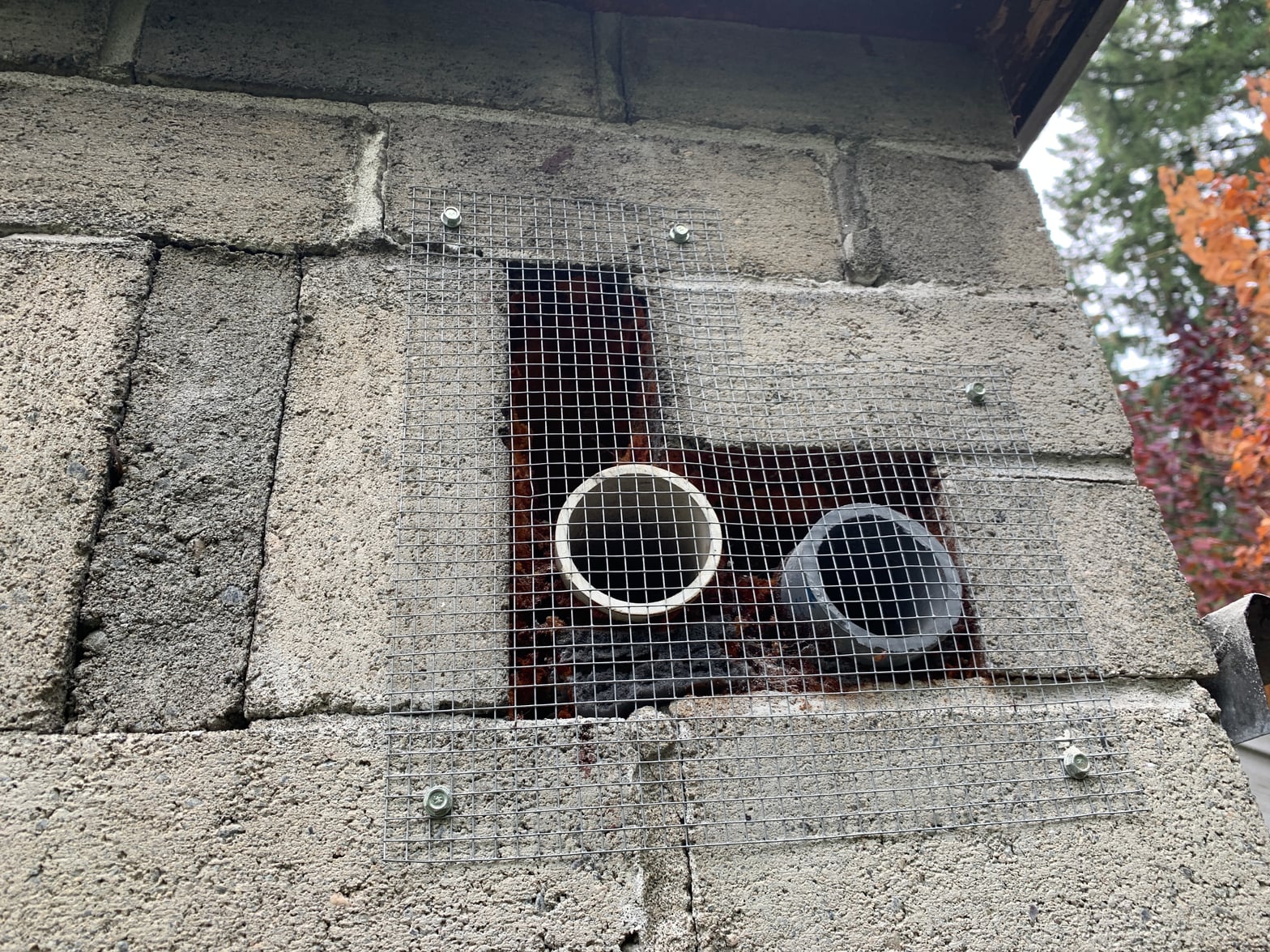
If you can't tell which opening is the real one, start with a pest-proofing inspection and look at the exterior line first. Our house mouse page covers the species in more detail, and the DIY pest-proofing guide covers the steps you can take yourself.
Sources
- University of Nebraska-Lincoln Extension, Rodent-Proof Construction (2009): https://extensionpubs.unl.edu/publication/g1530/na/html/view
- University of Georgia CAES Field Report, People, mice head indoors for winter (2010): https://fieldreport.caes.uga.edu/people-mice-head-indoors-for-winter/
Frequently Asked Questions
NewGen Pest Control Team
Pest control specialists serving Greater Vancouver since 2016.7× Consumer Choice Award winners.