

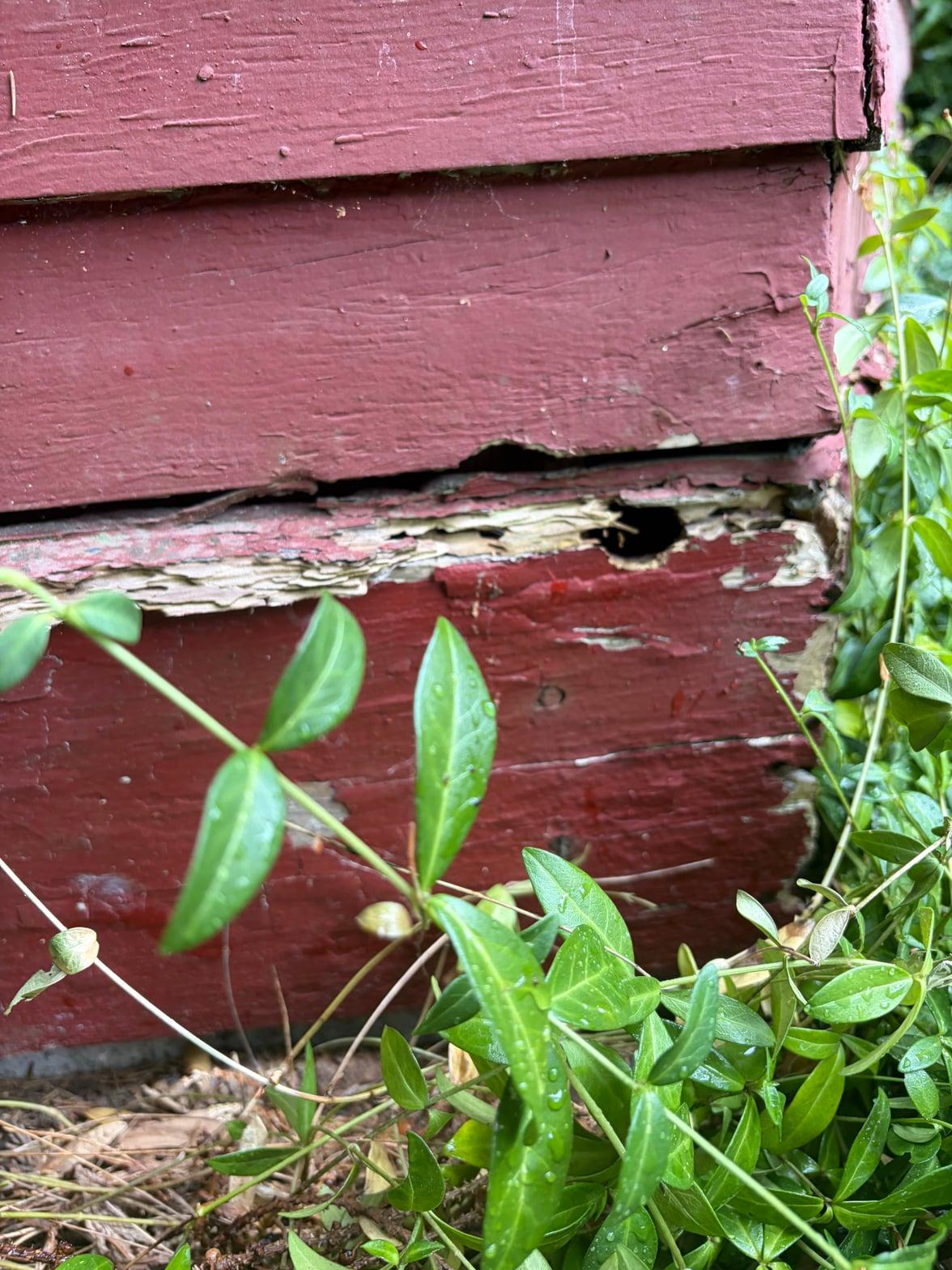
Rodents working through brittle belly band boards in Vancouver
The call came in because mice were getting into a Vancouver house, and the trail led straight to the belly band boards wrapping the foundation. These are the trim boards that run around the base of the house, and on this property they'd gone soft and brittle in long stretches. Screws wouldn't hold in them anymore, which told the crew a lot before they'd even opened a wall cavity.
The owner was weighing whether to have the boards replaced outright or patched in place, and the house was likely headed for sale as-is. That decision mattered for scope: this wasn't a simple spot treatment, it was a judgment call about what level of repair the entry points actually needed.
Soft wood, open seams, and a handful of entry gaps
Once the crew was on site, the gaps weren't limited to the belly bands. A dryer vent had no cover. Three doors, including underneath the front door, had no sweep. The rear window frame had an open seam, and the basement fireplace had a gap large enough for rodents to use. A possible mouse nest was also reported in the sun room.
The belly band boards themselves were ruled out for spot treatment. The wood was too degraded in most sections to hold fasteners reliably, and patching tiny sections individually would have meant screwing into the foundation itself in places, running flashing under nearly the entire perimeter, and risking more damage to boards that were already failing. Full board replacement was the better fix, but that was work for the client's own contractor, not part of this scope.
Sealing vents, doors, and gaps while running a trapping program
With the boards set aside as a separate repair, the crew sealed everything else in one visit: two rodent-proof dryer vent covers, three 36-inch door sweeps, concrete around the basement fireplace gap, and sealing around the front door and rear window frames using 1/4-inch mesh, perforated strip, and excluder stuffing. Ten ambush stations and ten Protecta Jr. stations went in, split between interior and exterior placements, to start pulling down any rodents already inside while the sealing held the line against new entry.
The plan called for a follow-up visit roughly one to two weeks later to pull everything and close the job out. On that final visit the technician checked all stations for catches before removing them, documented activity, and finished a piece of flashing under the rear window with three screws that had been left for a later trap check. Leftover concrete debris around the interior fireplace was swept up as part of the same visit.
The Outcome
We were hired to stop rodents getting in through the vent, doors, window, and fireplace gaps, and to clear out any that were already inside. That work is done: the entry points identified are sealed, and the trapping equipment has been pulled after a documented final check.
Vents, doors, and gaps sealed, equipment pulled
- The dryer vent, three doors, the rear window frame, and the basement fireplace gap are all sealed with rodent-proof covers, sweeps, mesh, and concrete.
- The trapping program ran through interior and exterior stations until the final visit, when catch activity was checked and documented before every trap and station was removed.
- The flashing detail under the rear window was completed on the closing visit, finishing off a seam that had been left for the last trap check.
- The belly band boards remain a separate repair item for the client to address through their own contractor, since full replacement was the only durable fix for wood that soft.
The sealing work covers every entry point this crew controlled directly, which is the piece that keeps new rodents from getting back in no matter what happens with the boards. For houses with similar perimeter trim problems, our entry-point exclusion and mouse control services cover both the sealing and the trapping side of a job like this, and our house mouse page goes into how these entry gaps form around older foundations in the first place.
Need Entry Point Exclusion?
Professional-grade sealing of gaps, vents, soffits, and utility penetrations across the entire structure.
View Entry Point Exclusion