

Mice getting into a Vancouver home through heat registers and door tracks
The homeowner had been dealing with mice for a while, and the activity wasn't random. It was coming through a short list of specific spots: a heat register tucked behind an angled shelf in the living room corner, a bedroom heat register where the cutout met a wall cavity, a gap under a closet door track in the opposite bedroom, and a stretch of office wall where the baseboard was simply missing. Mice don't need much, a gap the width of a pencil is enough, and heat registers and door tracks are exactly the kind of overlooked openings that let them move between a wall cavity and a living space without anyone noticing until the droppings show up.
What made this job different was timing. The homeowner was also having her carpet replaced, and the two projects needed to happen in the right order. Pull the carpet, seal the walls and the gaps the carpet had been hiding, then lay new carpet down over clean, closed-up edges. Get the sequence wrong and you're either sealing under carpet you can't fully access, or installing new flooring over gaps that are still open.
Entry points mapped before the carpet came up
An earlier assessment had already documented the entry points room by room: the living room heat register, the bedroom heat register and its wall cavity connection, the closet door track gap, and the bare baseboard run in the office. The assessment had also flagged a kitchen concern worth watching. Previous stuffing work was visible around the dishwasher, but one side of it was either removed or never finished, and ongoing activity there was suspected even though the appliances hadn't been pulled out to confirm it.
That kitchen note turned out to matter. On the service date, the carpet had been pulled the day before as planned, which opened up the living room floor and tack strip line for proper access. But the dishwasher was still connected to plumbing and electrical, and the stove sat inside a cabinet close to a foot off the ground, both out of reach without disconnecting appliances. Lower cabinets were also full of stored items at the time, so that run of wall couldn't be checked either.
Sealing the living room ahead of new carpet
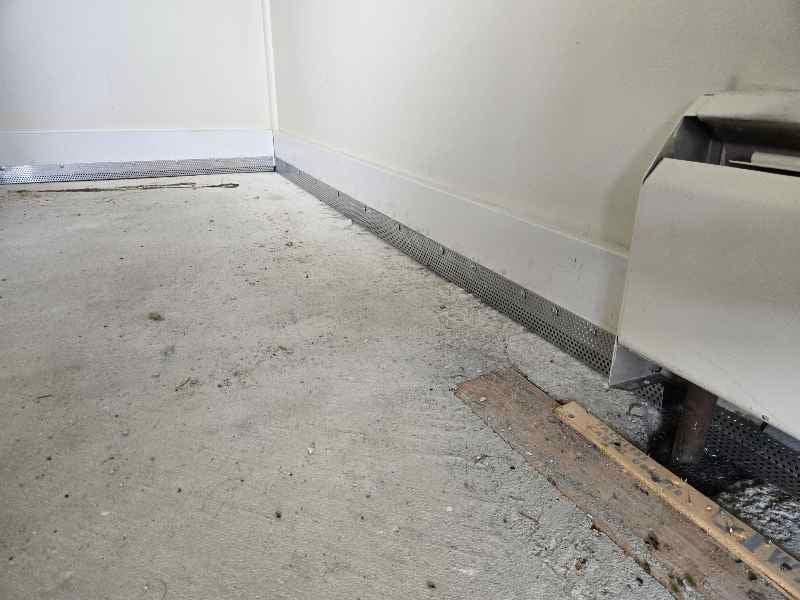
With the carpet already pulled, the crew stripped the old tack strips out of the living room, swept and scraped the exposed drywall edge to get a clean line, and installed roughly 60 feet of flashing along the wall base, backed up with excluder stuffing where the flashing alone wouldn't close a gap. That work had to be finished before new flooring went back down, so the living room was the priority.
From there the work moved through the bedrooms: sealing the gaps under both door tracks and closing the wall cavity connection behind the bedroom heat register, the same cavity that had been letting mice travel between the wall and the room. The fridge was pulled out as well, and the opening behind it was packed with excluder stuffing.
The dishwasher, stove, and cabinet run couldn't be addressed on this visit. Getting behind the dishwasher means disconnecting it from plumbing and electrical first, and the cabinets needed to be cleared before anyone could see what was actually behind the stove. Both are jobs for the homeowner to arrange ahead of a follow-up, not something a technician can safely do mid-visit.
The Outcome
We were hired to close the specific entry points behind the recurring mouse activity, on a schedule that worked around a carpet replacement already underway.
Living room sealed and carpet-ready, kitchen area flagged for follow-up
- The living room entry point behind the shelf is fully sealed with flashing and stuffing, and the floor was ready for new carpet to go down the following day.
- Both bedroom door track gaps are closed, and the bedroom heat register wall cavity that was letting mice move between the wall and the room is sealed.
- The opening behind the fridge is packed with excluder stuffing.
- The kitchen appliance area is flagged for a follow-up visit, since it needs access the homeowner has to arrange first, a dishwasher disconnect and cleared cabinets so the stove area can be checked.
- Because this is an interior-only exclusion with no exterior treatment, the homeowner was advised there's no warranty against mice re-entering through unaddressed exterior gaps.
Sequencing matters on jobs like this. Sealing a living room wall before new carpet goes down means the fix is actually covered and protected rather than sitting exposed under old flooring that was part of the problem. For anyone dealing with similar activity, our mouse control and entry-point exclusion pages cover how we trace activity back to a building's actual gaps rather than just placing traps, and the house mouse profile explains why heat registers, door tracks and baseboard gaps are such common access points in older homes.
Need Mouse Control?
Full-property baiting, trapping, and entry point sealing to eliminate and prevent mouse activity.
View Mouse Control