

Mice in a Vancouver house with a basement suite
This Vancouver house had a history of mouse activity, and the client chose our guaranteed mouse-proofing program. The home has a main floor, a basement suite with its own door, a rear deck with storage cabinets underneath, a closed front porch and an addition at the back right corner. That adds up to a lot of places where siding, stucco, concrete and wood meet.
Our inspection found plenty of reasons for mice to be getting in. We counted siding gaps along about 40 feet of the perimeter, open corners where stucco meets siding, gaps around both the basement suite door and the rear deck door, a vertical seam where siding meets the foundation, and missing stucco under a front window. The client chose our guaranteed mouse-proofing program. It pairs a full exterior seal with one-way doors and trapping, runs bi-weekly follow-ups for three months, and carries a one-year warranty against mice getting back in.
The quote also included a hell pit disclaimer. A hell pit is a hidden void or burrow system under or beside a foundation where rodents can live and tunnel out of sight. At inspection we couldn't confirm it or rule it out. The exterior gaps were enough to explain the activity, so we started with the visible entry points.
Tunnels and soft stucco at the back corner
The rear addition was approved for trench and mesh on site. Once the crew started digging along the back right corner, the ground showed far more than the surface had: large openings and underground tunnelling that couldn't be seen during the original inspection.
The wall above the trench had its own problem. The stucco there was soft and rotting, too weak to hold fasteners at the usual height. To get a solid anchor, the technicians fixed the mesh higher up the wall than they normally would.
Taken together, the deteriorated walls, the tunnels and signs of a possible concealed void near the basement looked like a hell pit condition. Sealing the surface over an active burrow system can leave rodents living under the house with no reason to leave.
Sealing the deck, doors and foundation line
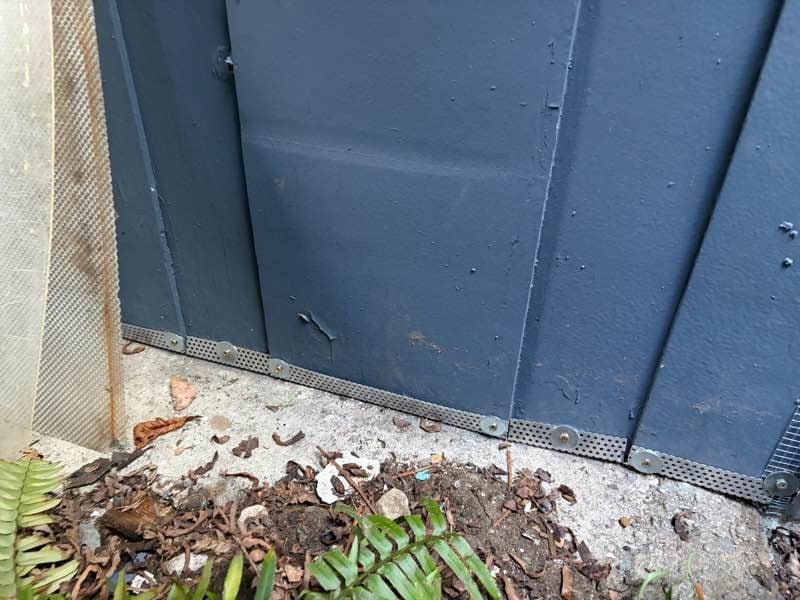
The first day covered the rear half of the house. Two technicians worked under the back deck and closed every gap along its underside with perforated angle flashing and 1/4" mesh. Every cupboard door under the deck was treated, and the leftmost one got a RodExit door sweep.
- Mesh caps went on the basement suite door frame.
- Gaps under the upstairs back door frame and open corners were packed with Excluder stuffing.
- Trench and mesh along the rear addition was completed up to the backyard gate, with the mesh anchored higher on the wall where the stucco had rotted.
The crew documented the work and the new findings in nine service photos and logged four remaining items: several more feet of trench and mesh behind the side gate, the front porch, concrete repair under the front left window, and setting up the stations.
We then stopped the trench work on purpose. Instead of extending the mesh into ground that might hide a void, we proposed a focused two-technician inspection, possibly drilling an access point and running a scope, to look into the concealed area. The front porch was also flagged for a closer look to see whether the tunnels run under the foundation. Once we know what's down there, the rest of the exclusion can be planned around it.
The Outcome
We were hired to mouse-proof this house and back it with a warranty. The rear of the house is sealed, and the finish is on hold until we know whether a hidden void sits under the foundation.
Rear of the house sealed
- The underside of the back deck and its storage cabinets are closed off with flashing, mesh and a rodent-proof door sweep.
- Both back entries, the basement suite door and the upstairs deck door, are sealed at the frame.
- The rear addition has a buried mesh barrier along its base, fixed into sound wall above the rotted stucco.
- The tunnelling at the back corner was found and documented before any more mesh went in over it.
On a house like this, a mesh trench works only if the ground behind it is solid. Mice will follow an existing tunnel system rather than dig a new one, so a hidden void under the slab would undercut the sealing on the surface. Checking for that void before finishing the side gate and front porch is how we make sure the warranty work holds.
Read more about how we approach mouse control, our entry-point exclusion work, and what a hell pit looks like.
Need Mouse Control?
Full-property baiting, trapping, and entry point sealing to eliminate and prevent mouse activity.
View Mouse Control More mouse control in Vancouver

