

Two wasp problems at one Vancouver house
The first call was about wasps at the storage room of a Vancouver house. An active paper wasp colony was nesting in a crack in the pavement where the concrete floor meets the base of the storage room wall. The technician treated the void through that entrance with Dragnet FT. Dead wasps were already lying around before treatment, which suggested the colony was under stress. How deep the void ran below the surface could not be determined.
That raised the first judgment call: don't seal the crack yet. Sealing a nest entrance while wasps are still active can trap them in the void or push them to find another way out. Our report advised leaving the crack open until activity had fully stopped, then repairing or sealing it to cut the chance of a new colony moving in.
Yellowjackets behind storage from floor to mid-wall
At the follow-up visit the crack colony was inactive. A second problem had appeared, though. Four to eight yellowjackets were flying near a light fixture at the back of the basement. That part of the basement was packed with stored items from the floor up to about mid-wall.
Yellowjackets nest in dark, enclosed spaces, so the nest could have been anywhere behind that storage. The standing plan for this house was not to force access through stored items. Instead, the technician worked on what could be reached. Drione dust went onto every accessible surface where yellowjackets had been seen, and the homeowner was asked to reduce the clutter so the suspected nesting area could be opened up.
The dust kept working. The homeowner got in touch to say she was still finding dead wasps, but far fewer. At the next visit the technician found the same pattern: about 10 to 15 dead wasps and two sluggish live ones, which were dusted. Activity had dropped sharply since the previous service. The storage still blocked a full inspection. Around the same time, the homeowner sent a video showing an exterior entry point with holes in the wall.
Treating the nest once the basement was cleared
After decluttering, the homeowner found the nest herself in the rear basement, near where the wasps had been flying. She asked that it be confirmed fully dead before anyone removed it.
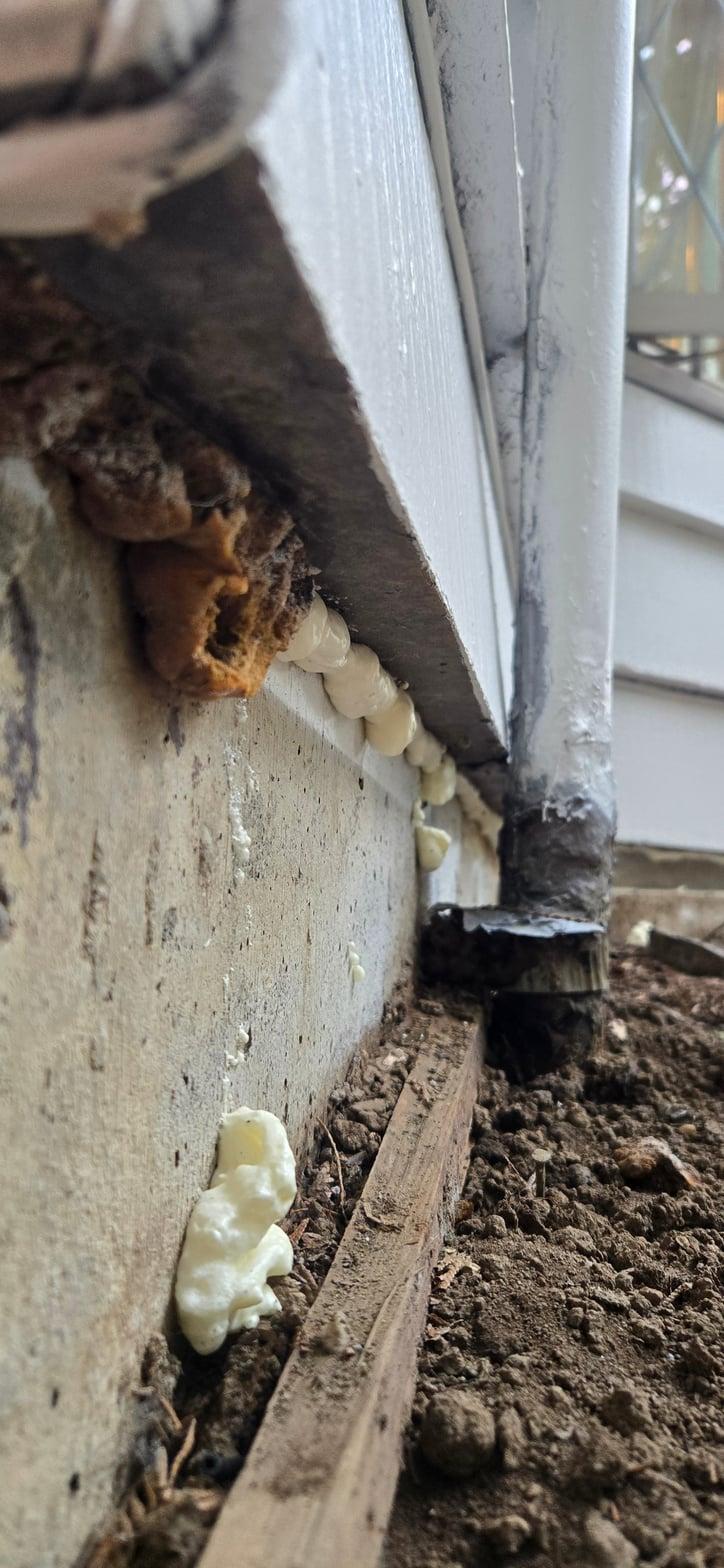
With the space opened up, the technician inspected the area and treated the exposed nest. By then it looked largely inactive, with only a few dead wasps on it. Because there were signs of recent activity, precautionary dust went into the interior cracks and crevices as well. The technician also rechecked the exterior entry point, which the homeowner had already sealed with spray foam. The nest was left in place, and a follow-up was booked for about a week later to confirm it was fully inactive before it was removed. That follow-up visit completed the job.
The Outcome
We were brought in to stop wasps nesting at this house. That covered the paper wasp colony at the storage room first, and then the yellowjackets in the rear basement. The work is finished.
Both wasp nests treated, job complete
- The paper wasp colony in the storage room floor crack was inactive by the first follow-up.
- The yellowjacket nest hidden behind the basement storage was found and treated once the space was cleared, and was largely inactive by then.
- The exterior entry point from the homeowner's video is sealed with spray foam.
- The homeowner has two simple steps left: vacuum the remaining debris from the treated area, and watch for any renewed wasp activity or signs of another entry point.
This job came down to patience. The hidden nest could not be safely reached through the storage, so we treated where the wasps were actually travelling and let the dust bring the numbers down. Once the homeowner cleared the space, the nest could be dealt with directly. If you are seeing wasps indoors and cannot tell where they are coming from, our wasp and hornet control service starts with finding the nest and the way in.
Some photos on this page are representative photos from similar jobs our crews have done, not photos of this property.
Need Wasp & Hornet Control?
Safe removal of active nests from eaves, attics, and wall voids.
View Wasp & Hornet Control More wasp & hornet control in Vancouver

