

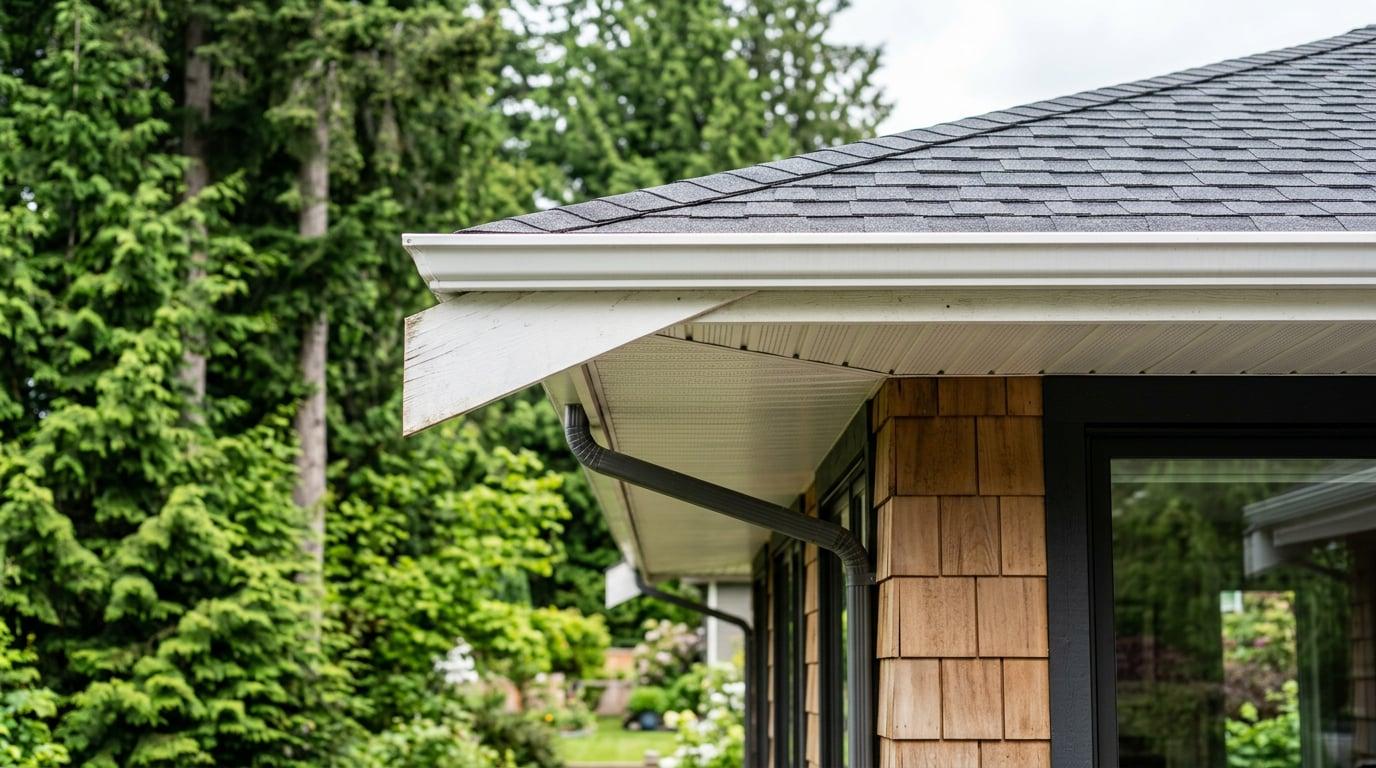
Wasps flying in and out of one spot in the lower eaves
The homeowner kept seeing wasps fly in and out of one spot in the lower eaves, about ten feet up on the south side of the house, near a rhododendron. They believed there was a nest in the eaves, and they were right. A wasp colony doesn't need a large opening. A small gap in a soffit or fascia board is enough, and once the workers find it they use the same route all day.
Wasps like sheltered, dry voids under eaves, inside soffits, behind fascia boards and in wall cavities. These spaces stay out of the wind and rain, so a nest can grow for weeks before anyone notices. Colonies are at their largest in late summer and early fall. That is when more workers are coming and going, and it is often when an owner first notices a steady stream at one spot.
A nest hidden in the soffit void, with traffic at one gap
Watch for traffic. If wasps keep landing at the same gap at the same height, the nest is probably right behind it. Stand a few metres back and watch for a few minutes. You don't need to see the nest to know it's there. With a nest inside a wall cavity, you may also hear faint rustling or chewing behind the wall, or find the odd wasp indoors.
Our technician confirmed active wasps at the soffit entry. The nest was concealed in the void and couldn't be reached. That is where the usual fixes fail. Spraying the outside of the gap only hits the few wasps that land on it, and the colony inside carries on. Knocking down a nest you can see does nothing about one hidden in a void. Plugging the entry while the colony is still active cuts the wasps off from their only route. They can then chew their way out somewhere else, sometimes through drywall into the house.
Dust placed into the entry, and the gap left open on purpose
The technician applied an insecticidal dust directly into the access point and the void behind it. Dust works differently from spray. Wasps walk through it, it clings to their bodies and they carry it into the nest, so it reaches a colony that spray can't. That's why the dust went into the entry and not over the outside of the soffit.
The soffit opening was then left open on purpose. The instructions on the job were clear: don't close it until wasp activity has stopped. Closing an active access point early can interfere with the treatment and redirect surviving wasps. A follow-up visit was booked to check the entry point and the roofline directly above the soffit for live wasps or signs that the nest was still active.
The Outcome
We were called because wasps were using a gap in the lower eaves and the homeowner believed there was a nest behind it. The nest was treated, and the follow-up visit confirmed the treatment worked.
The wasps are gone from the eaves
- The nest hidden in the soffit void was treated through the same gap the wasps were using.
- At the follow-up visit there were no live wasps and no sign of nest activity at the entrance above the soffit.
- The treatment was recorded as successful, and no second treatment was needed.
- If wasps show up again around the roofline or soffit, the report recommends booking a follow-up inspection.
The treatment was applied on one visit, and the follow-up was an inspection. The gap stayed open while the wasps were still active, and the follow-up found no sign of wasp activity.
If you see a steady stream of wasps at one gap in your eaves, watch it from a distance. Don't poke at it, and don't spray an aerosol into the void yourself. Once activity has clearly stopped, close the gap with metal mesh or a properly fitted soffit panel. Wasps rarely reuse an old nest, but an open, sheltered void can attract a new queen looking for a nest site in spring, so close the gap before then. Call a technician if the entry is too high to reach safely, if it's in a wall rather than an eave you can get to, or if the traffic comes back after a first treatment. Our wasp and hornet control team handles the treatment, and entry point exclusion covers closing off the gap once it's safe to do so.
The main image on this page is an AI-generated illustration, not a photo from this job.
Need Wasp & Hornet Control?
Safe removal of active nests from eaves, attics, and wall voids.
View Wasp & Hornet Control More wasp & hornet control in Vancouver

